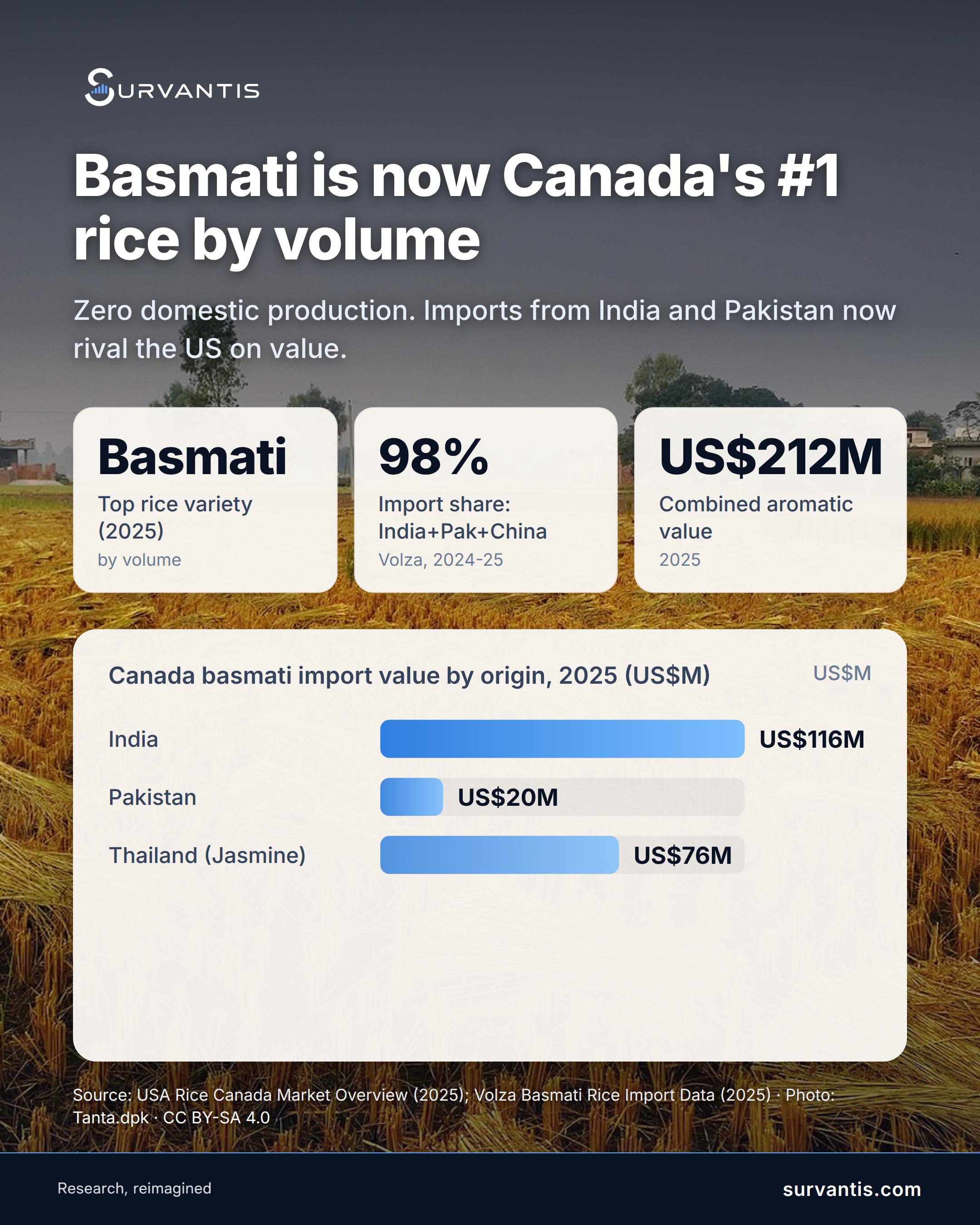
That's a quiet shift with real consequences for anyone selling packaged food into Canada. US rice has long held the majority of the broader Canadian rice market, but it's losing relative ground as South Asian immigration reshapes demand. Indian immigrants alone accounted for about 18.6% of newcomers since 2016, and they've brought a strong preference for basmati and jasmine over US long-grain.
The supply side tells the same story: India, Pakistan and China together account for 98% of Canada's basmati imports, with 1121 Sella the most requested variant on store shelves. Brand shelves now mix India Gate, Daawat, Kohinoor and Tilda against legacy names like Lundberg, fighting it out mostly through ethnic grocery chains and online channels in Ontario, British Columbia and Alberta, the three provinces with Canada's largest South Asian populations.
For an exporter, this is a market entry case study in miniature: no domestic competitor to displace, a defined import pathway, and demand concentrated in a handful of metro areas. The open questions are the practical ones, labelling rules, duty treatment by HS code, and which province to pilot in first.
If you're sizing this kind of opportunity, how are you currently tracking which import brands are actually winning shelf space, and would a structured read on the Canadian basmati trade be useful to you? That's exactly the kind of three-pillar view Radar builds for a market like this.
Sources
#MarketResearch #MarketEntry #ExportStrategy #FoodAndBeverage