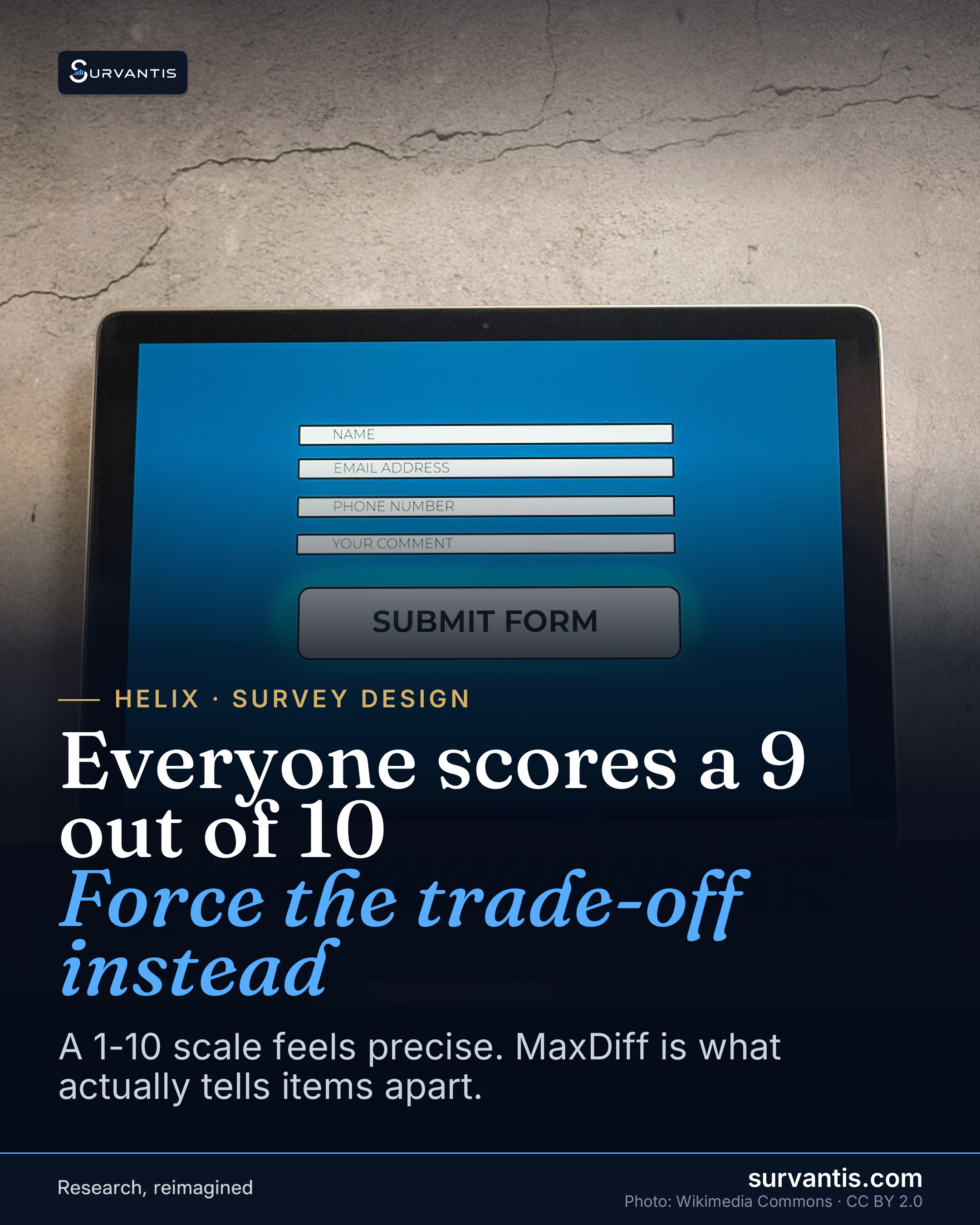
That's the real argument for MaxDiff. Instead of rating items in isolation, respondents see a small set, say four or five items, and pick the one that matters most and the one that matters least. Repeat that twelve times with different mixes and you get a forced ranking across the whole list, not a wall of identical scores.
A few things we'd flag if you're building one:
- Keep the item list between 10 and 30, all at the same level of detail (don't mix “faster checkout” with “better experience”)
- Four to five items per set is the sweet spot, more adds fatigue without adding much signal
- Stop around 20-25 sets. Past that, engagement drops fast
- Rotate items so each one shows up roughly the same number of times
- A short heads-up before set one (“you'll see this again with different items”) cuts confusion
We built MaxDiff logic into Helix because the balancing and rotation is exactly the kind of thing that shouldn't require a statistician to set up by hand.
How are you prioritizing features or claims in your next study, scales, ranking, or forcing the trade-off?
Sources
#MarketResearch #SurveyDesign #MaxDiff #DataQuality