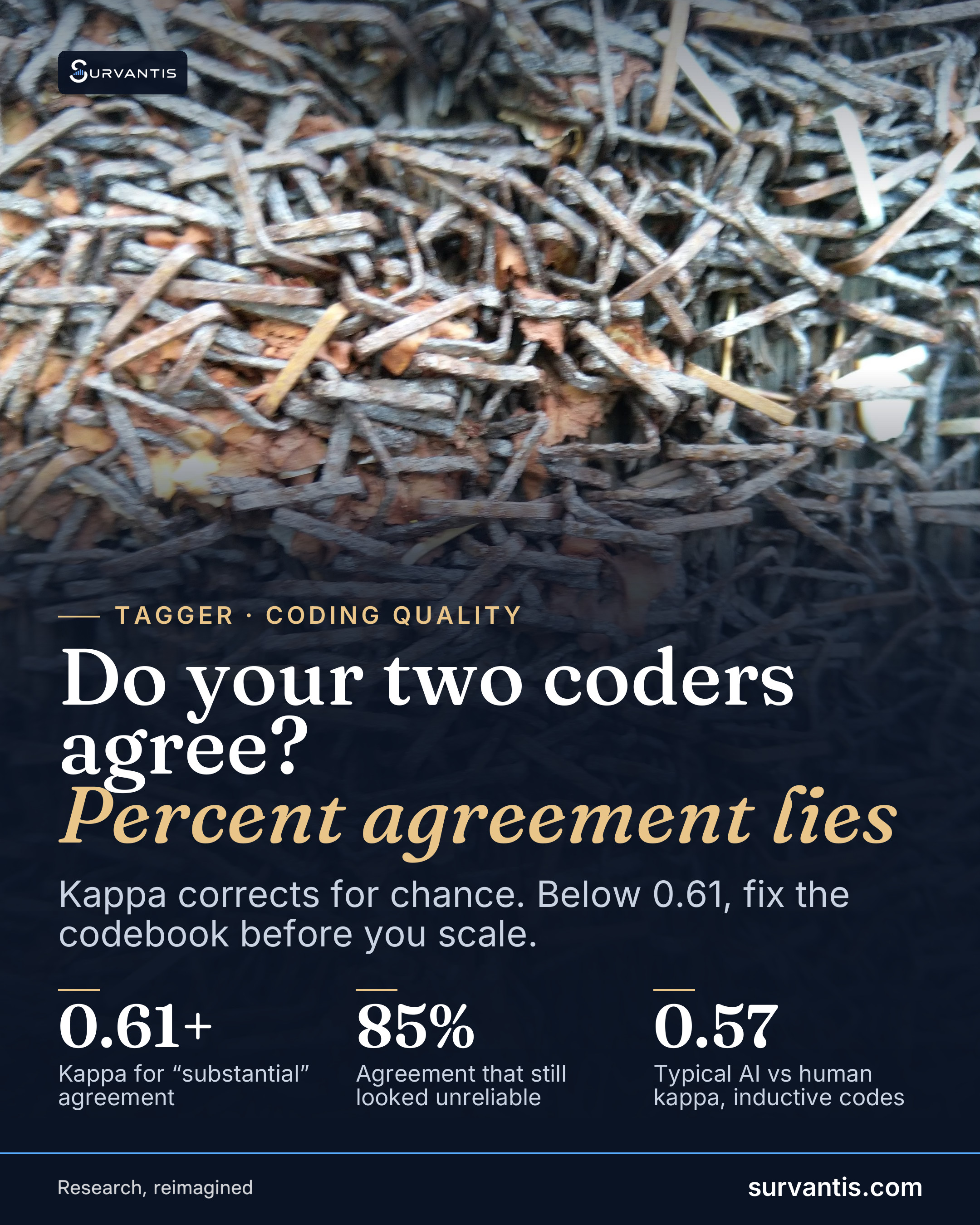
That gap is why percent agreement alone shouldn't be the gatekeeper for coding quality, whether your coders are two humans, two AI runs, or one of each.
The workflow we recommend before any codeframe goes into production:
- Pull a subset (10-20% of verbatims is plenty for a first pass)
- Have two coders code it independently, no sharing notes, no seeing each other's codes
- Calculate percent agreement AND Cohen's kappa, because kappa corrects for the agreement you'd get by pure chance
- Treat kappa below 0.61 as a stop sign, not a footnote
The 2026 twist: more teams now run this check with one human coder and one AI coder. Clear-cut, deductive codes (“mentions price,” “mentions delivery”) tend to hold up fine. Interpretive or inductive themes, the ones requiring judgment calls, are where agreement drops, sometimes well below the human-to-human baseline.
When kappa comes in low, don't just retrain the coder and hope. Rewrite the codebook definitions, add examples for the edge cases, or tighten the AI prompt, then re-test on a fresh subset before you commit the full dataset.
How do you currently check whether your open-end coding, human or AI, is actually reliable before you report the numbers? Tools like Tagger build this kind of check into the codeframe step, so you catch the drift before it reaches the topline.
Sources
#MarketResearch #DataQuality #SurveyDesign #QualitativeResearch