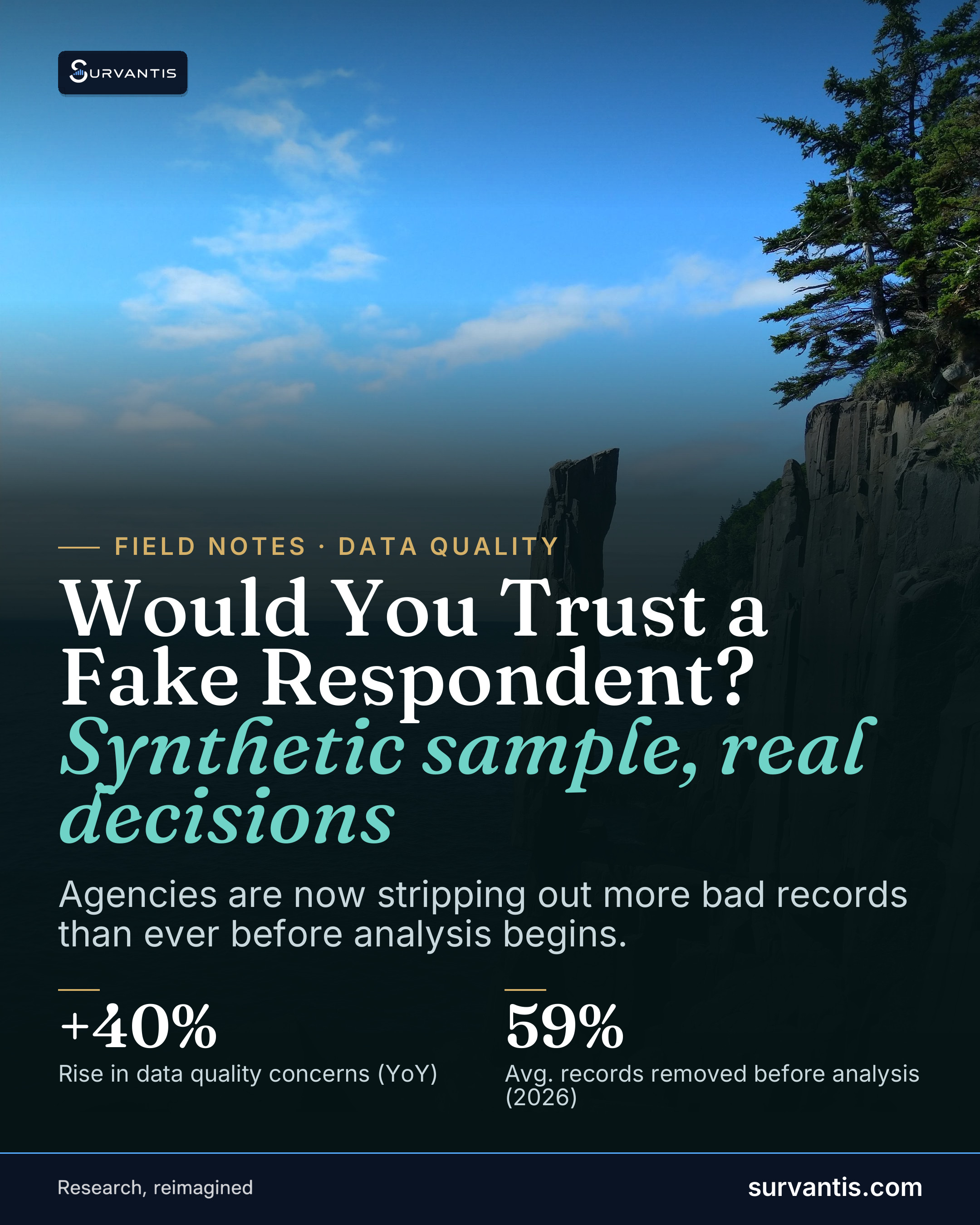
At the same time, GRIT's practice report found data quality concerns up 40% year over year, with synthetic respondents and Gen Z survey fatigue named as the main drivers. The fraud got better at its job too: fluent, on-topic, polite. The lazy tells (speeding, gibberish, blank fields) that used to flag a bad respondent don't work the same way anymore.
So here's the real question for anyone running studies right now: where's your line?
- Do you allow any synthetic or AI-assisted responses into a study at all, even for pretesting?
- If yes, how do you validate it before it touches a real deliverable?
- Has this changed your sampling budget, more validation steps, smaller samples, extra vendor checks?
We hear wildly different answers to this depending on who you ask, agency, client-side team or independent consultant. Some won't touch synthetic data for anything that reaches a client deck. Others blend it in quietly and never mention it.
How do you handle this today, and would you tell a client if synthetic data was part of their results? If you're building the survey itself, this is exactly the kind of validation logic a tool like Helix is built to help catch early, before bad data ever reaches analysis.
Sources
#MarketResearch #DataQuality #SurveyDesign #MarketIntelligence